How to Build a Lasagna Garden Bed Without Digging
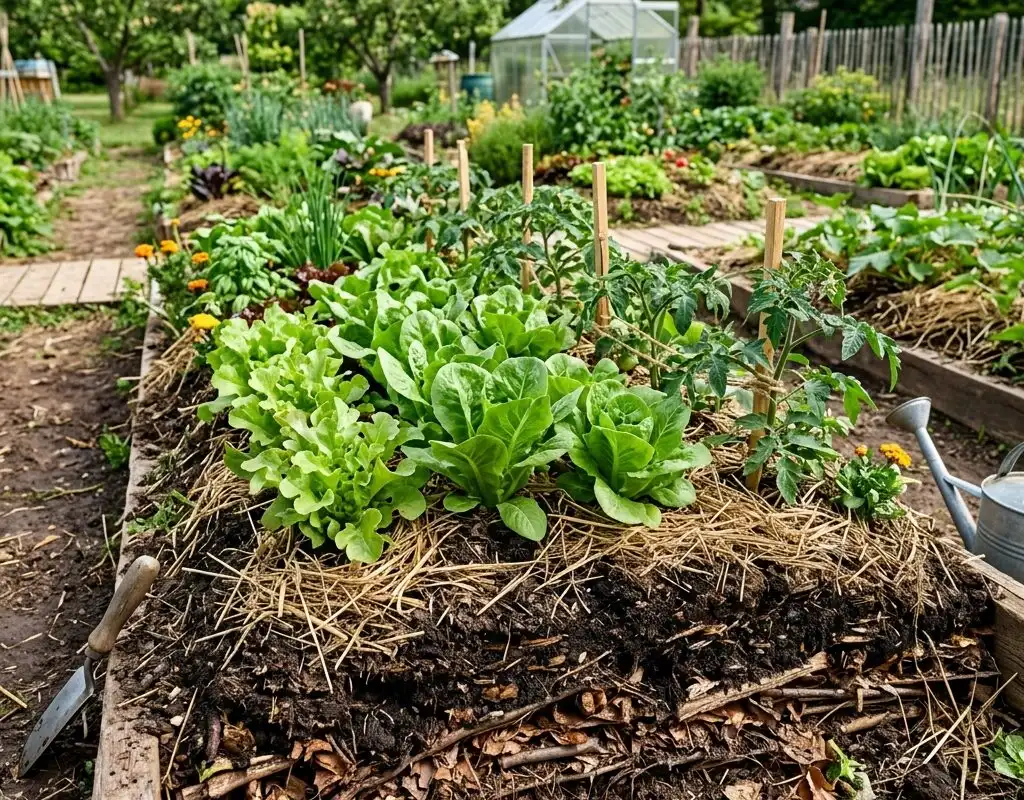
A lasagna bed is not a fixed recipe of two parts brown material to one part green. It is a surface-built growing bed made with the organic matter available to you. Success depends more on the starting ground, the maturity of the planting layer, moisture and drainage than on a decorative sequence of layers.
Choose the right approach first
| Starting point | Sensible approach |
|---|---|
| Existing cultivated bed with few weeds | Skip cardboard and spread mature compost directly. |
| Grass or annual weeds | Overlap plain brown cardboard, remove tape and staples, then add mature compost. |
| Brambles, couch grass or persistent rhizomes | Remove persistent crowns and roots first; cardboard alone may not solve them. |
| Heavy, waterlogged ground | Address drainage and access; organic layers do not cure waterlogging. |
A practical no-dig sequence
- Mark an accessible bed. About 1.2 m wide is a useful access guide when the bed can be reached from both sides, not a compulsory dimension.
- Cut vegetation and remove woody or persistent weeds. Leave the soil profile in place rather than turning the whole area.
- Use cardboard only where it helps. Choose plain non-glossy cardboard, remove labels, tape and staples, overlap it and wet it.
- Add a mature growing layer. RHS guidance uses 10–15 cm of well-rotted compost or manure to start a no-dig bed. Treat that as a starting point, because materials and soils differ.
- Plant into mature material. If an amendment is hot, steaming or strongly odorous, allow it to finish decomposing before roots enter it.
- Maintain from the surface. A yearly layer of mature organic matter, commonly around 5 cm, replaces rebuilding the whole stack. Watering still follows weather and crop needs.
Chatelain marker. A smaller bed with enough mature compost is safer than a large stack of fresh material that leaves seedlings without a stable rooting zone.
Where green and brown material belongs
Leaves, fine woody chip, straw and soft green waste can feed a compost heap or sit below the planting layer. They do not instantly become a uniform growing medium. Thick fresh grass clippings can compact and turn airless; coarse branches leave voids; very woody material can temporarily tie up nitrogen at its surface.
The predictable route is to keep unfinished material below a proper layer of mature compost, or compost it separately. Meat, cheese and oily cooked food do not belong in an open garden bed because they can attract animals.
Plant now or wait?
Immediate planting is reasonable when roots have a sufficiently deep layer of mature organic matter. Fine seed needs an especially even, settled surface. Where most of the stack is fresh, allow time and check heat, settlement and moisture before sowing.
Common failure points
- Treating a surface bed as a universal drainage fix.
- Leaving plastic tape, glossy coatings or staples on cardboard.
- Burying a dense mass of fresh grass clippings.
- Planting straight into fresh manure or unfinished compost.
- Promising a bed that never needs water: mulch reduces evaporation but does not replace rainfall or irrigation.
- Walking on and compacting the growing area.
FAQ
Is cardboard essential?
No. It is mainly a temporary weed-smothering layer. Mature compost can go straight onto a reasonably clean existing bed.
Must green and brown layers follow an exact ratio?
No. Carbon and nitrogen matter to decomposition, but real materials vary too much for a visual universal ratio to guarantee a result.
Is a high raised bed always better?
No. A ground-level bed lets roots reach the soil below. A raised structure is useful when access or poorly drained heavy ground justifies it.