Gabions in the Garden: A Modern, Draining and Durable Wall
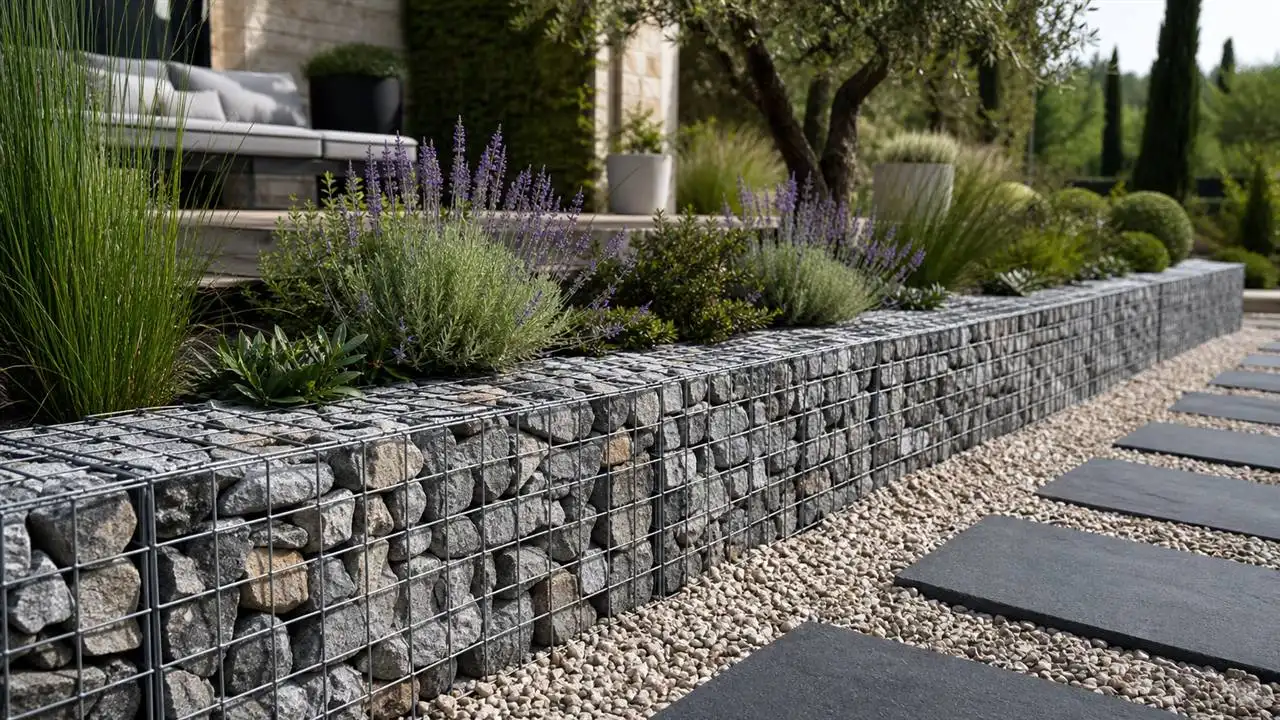
A gabion is a metal cage filled with stone: a wall, retaining structure, screen or bench, built without mortar, naturally draining and built to last decades. Robust and contemporary, it can level a slope or structure a terrace in a weekend. Here’s how to build and fill one properly.
The Chatelain Method for gabions
You observe the purpose (decorative or retaining) and height; you diagnose the right cage and fill; you correct with a stable base; you prevent bulging with internal ties for taller structures.
Why choose gabions?
| Strength | Detail |
|---|---|
| No mortar | Dry build, quick to assemble |
| Free-draining | Water moves freely between the stones |
| Durable | Galvanised steel + stone = decades |
| Versatile | Wall, retaining structure, screen, seating |
The Chatelain note. For a retaining gabion, base and thickness matter: plan a wide footing, a stable bed, and internal tie wires beyond a certain height to avoid bulging. Beyond a decorative role, a genuine retaining wall is a job for a professional.
Building and filling
- Stable base: a level, compacted gravel bed.
- Assemble the cage, galvanised, clipped or laced together.
- Fill with graded stone, flat faces to the visible side, tamping as you go.
- Cap the top neatly for a clean finish.
A gabion should stay a wall, not become a decorative cage
Gabions have won over contemporary gardens because they look simple: a cage, some stone, a modern effect. But that simplicity is deceptive. Poorly filled, too tall, too thin, or built without a drainage strategy, a gabion quickly becomes heavy and artificial.
Its origin is fundamentally technical: to contain, drain, stabilise. That utilitarian character is exactly what makes it beautiful when done well. In a characterful garden, a gabion works best as a low retaining edge or a structural line, rather than a standalone sculpture.
| Point | Good choice | Poor choice |
|---|---|---|
| Stone | Angular, local where possible | Uniform rounded pebbles |
| Mesh | Regular, matched to stone size | Mesh too wide |
| Height | Proportioned to the slope | A solid wall with no breathing room |
| Planting | Grasses, lavender, restrained perennials | No planting around it at all |
The best resolution is usually restraint: a low gabion of 50-80cm, well aligned, planted above, beats a tall wall that encloses the garden.
FAQ
Can a gabion work as a retaining wall?
Yes, for moderate, well-sized heights. For a genuine load-bearing retaining wall, design and installation should go to a professional.
What stone goes inside a gabion?
Graded stone, larger than the cage mesh, ideally with flat faces turned toward the visible side for a neat finish.
Does a gabion rust?
The cage is galvanised steel (sometimes coated): it resists for decades. Avoid impacts that damage the galvanising.
Does a gabion need a foundation?
A stable, draining base (a level, compacted gravel bed) suffices for a decorative gabion; a retaining structure needs more care.