Spring onion
Allium cepa L. harvested young — distinct from the Welsh onion, Allium fistulosum L.
Not a species but a stage: an onion pulled before it swells into a bulbA rounded underground organ that stores a plant's reserves during dormancy. and runs to flower. Hence the constant mix-up with the Welsh onion, which never bulbs at all.
A spring onion is an onion (Allium cepa) harvested young, before flower stems appear and before a sizeable bulb forms: both the small white shaft and the green tubular leaves are eaten. Plain sun, free-drainingDescribes soil that lets water flow away easily, without pooling around the roots. soil, a quick and undemanding crop.
The name covers several different plants at the greengrocer’s. The useful distinction in the vegetable patch is simple: a spring onion would form a bulb if left to grow; the Welsh onion (Allium fistulosum) never will, even at full maturity.
Reliable figures before you plant
Several plants, one counter label
The vocabulary is loose, and that is the first source of error at the seed rack as much as at the greengrocer’s. Spring onion (also called salad onion by the RHS, or scallion in North American usage) is a young Allium cepa, pulled before its small white shaft has swollen into a bulb. The Welsh onion (Allium fistulosum) looks very similar but is a different species: it never forms a distinct bulb, even left in the ground. Chives are a much finer, perennial plant grown as a herb.
In the vegetable patch the consequence is concrete: if you want the option of either pulling young or letting the crop bulk up into a keeping onion, you need to sow Allium cepa. A Welsh onion will never give you that choice.
Sowing or sets: two speeds
Spring onions can be raised two ways, and they don’t take the same time. Sowing gives an even crop but calls for patience and careful early weeding — the young onion seedling is a thin thread of a thing and is quickly smothered. Planting sets (small bulbs held over from the previous season) get away much faster: they carry their own reserves, establish within days, and reach a pickable stage noticeably sooner.
| Your aim | Method | Why — and the trade-off |
|---|---|---|
| Quick harvest | Planting sets | Immediate start on stored reserves. ⚠️ risk of bolting if the set is oversized or hit by a cold snap. |
| Even stand, larger quantity | Sowing — ‘White Lisbon’ (RHS AGM) is the classic choice, hardy enough to sow almost year-round | Even, economical crop; no thinning needed. ⚠️ weed competition at the thread stage, weeding is essential. |
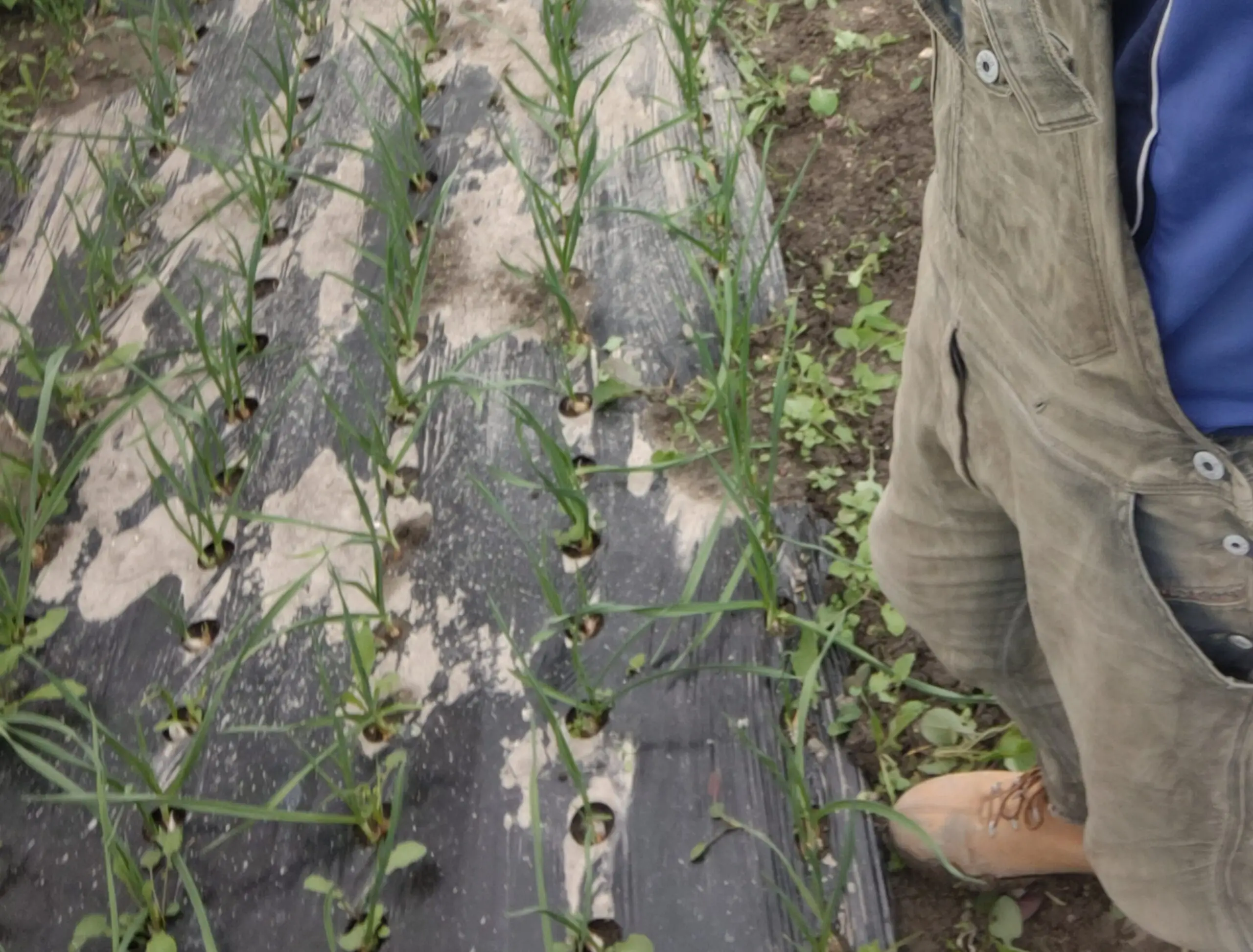
| Weed-free soil without weeding | Planting through mulchA layer of material (bark, straw…) laid on soil to retain moisture and limit weeds. film | The mulch blocks weeds and warms the soil. ⚠️ watering needs checking under film — you can’t see the soil dry out. |
The spring onion year
A cool-season crop that thrives in autumn and spring under mild climates, and suffers in strong heat, which speeds up bolting. ‘White Lisbon’ can be sown from March right through to autumn.
| Jan | Feb | Mar | Apr | May | Jun | Jul | Aug | Sep | Oct | Nov | Dec | |
|---|---|---|---|---|---|---|---|---|---|---|---|---|
| Sow | ||||||||||||
| Plant sets | ||||||||||||
| Harvest | ||||||||||||
| Bolting risk |
A spring onion isn’t a plant, it’s a calendar decision. The very same onion gives a spring onion if pulled in April, a keeping onion if left until summer. That changes completely how the crop fails: on a keeping onion, failure comes from poor storage; on a spring onion, it comes from a single event — bolting. As soon as a flower stem forms at the heart of the clump, the shaft hardens and turns fibrous — the vegetable is past its best. That is why it is grown in the cool season and harvested without delay: here, being early costs nothing, being late costs the crop.
Behaviour, mechanism and limits
It is one of the simplest crops in the vegetable patch, on one condition: clean ground at the start. The young onion seedling is a vertical thread with no leaf surface to speak of, unable to compete with a weed. Hence the value of planting through mulch film: the film settles the weeding question for the whole cycle and warms the soil as a bonus, which brings the harvest forward. The trade-off is real and often overlooked: under film, you cannot see the soil dry out, and watering has to be checked rather than assumed.
The mechanism to understand is bolting. The onion is biennial: it makes its bulb the first year, its flower the second. A sharp cold snap, or an already-large planting set, can trick it into behaving as though a winter has passed, triggering premature flowering. This is why smaller sets are preferred for spring onions.
An honest limit: this is not a keeping vegetable. Spring onions are eaten fresh, within days of harvest. Trying to store them like a dry onion makes no sense — they are two different products from the same plant.
Getting spring onions right
The heart of the clump
A firm, round stem at the centre signals bolting: harvest without delay.
Soft or yellowing leaves
Look first for waterlogging at the base: onions tolerate soggy soil poorly.
Weed early, or mulch
At the thread stage, any weed takes over. Planting through mulch film removes the problem.
Small sets, free-draining soil
Choose small planting sets and avoid hollows where water collects.
Read the sign, trace the cause, correct, prevent
Short cycle, harvested young: the spring onion escapes many of the problems of a stored keeping onion. The real risks concern water and timing.
| What you see | Likely cause | Correct | Prevent |
|---|---|---|---|
| Round, firm stem at the heart of the clump | Bolting | Harvest immediately: the shaft will toughen | Cool-season sowing, small planting sets |
| Soft base, rotting smell, plant loosening in the ground | Waterlogging or poor drainage | Remove affected plants | Free-draining soil, avoid hollows, don’t over-water under mulch |
| Leaves collapsing, tunnels in the bulb | Onion fly larvae | Lift and remove affected plants | Insect-proof mesh at sowing, rotate alliums |
| Grey down and leaf spotting in wet weather | Onion downy mildew | Remove affected foliage, improve airflow | Avoid overly dense sowing and overhead watering |
| Weak seedlings, swamped by weeds | Weed competition at the thread stage | Hand-weed urgently, without disturbing roots | Mulch, or a stale seedbed before sowing |
Keep intervention light: rotate alliums, free-draining soil, reasonable density. Any plant protection product must follow its label and current regulations.
The vegetable eaten whole
This is the whole point of the spring onion next to a stored one: both the white shaft and the green leaves are eaten, giving two textures and two intensities. The white part is mild and crisp, sliced thin and raw; the green, more herbaceous, is used like an herb, snipped in at the last moment so it doesn’t lose its flavour.
A guided choice, not an improvised one
We don’t start our spring onions from seed: we plant small sets, chosen on the advice of our professional plant nursery rather than a variety name we would have settled on ourselves — it is the nursery that guides us according to the season and what suits growing conditions here. That trust has its limits, as one incident showed: the year the sets we received were larger than usual, a good part of the row bolted before reaching a pickable stage, confirming that set size matters at least as much as variety. Like the aubergine, tomato and lettuce, spring onions are planted through black plastic mulch — the same settled weeding, the same vigilance needed for moisture building up underneath rather than on the surface.
What people ask most
What’s the difference between a spring onion and a Welsh onion?
A spring onion is an onion (Allium cepa) harvested young, which would form a bulb if left to grow. The Welsh onion (Allium fistulosum) is a different species that never forms a distinct bulb.
Is a spring onion the same as a scallion?
Yes, in North American usage « scallion » is the everyday word for what British gardeners call a spring onion or salad onion — an onion pulled before the bulb has formed.
Why do my spring onions bolt?
Because the onion is biennial: a sharp cold snap or an oversized planting set can trigger flowering. Choose small sets and grow in the cool season.
Can spring onions be stored?
No, this isn’t a keeping vegetable: eat it fresh, within days of harvest. To store, you need to let the onion reach full maturity instead.
Sources and verification
Last checked: 27 August 2026.
- RHS — Salad onions, grow your own: sowing, spacing, harvest, pests.
- RHS Plants — Spring onion ‘White Lisbon’: Award of Garden Merit cultivarA variety produced through selection or cultivation, distinct from the wild original plant., near year-round sowing.
- Kew Science — Plants of the World Online: taxonomic check of Allium cepa and Allium fistulosum.