Cep
Boletus edulis Bull., the cep group (with B. aereus, B. pinophilus, B. aestivalis)
A fungus you don’t grow, you encounter: partnered with a tree’s roots, it only fruits when soil, rain and warmth line up at the right moment. It isn’t a harvest you can schedule — it’s a find you learn to recognise.
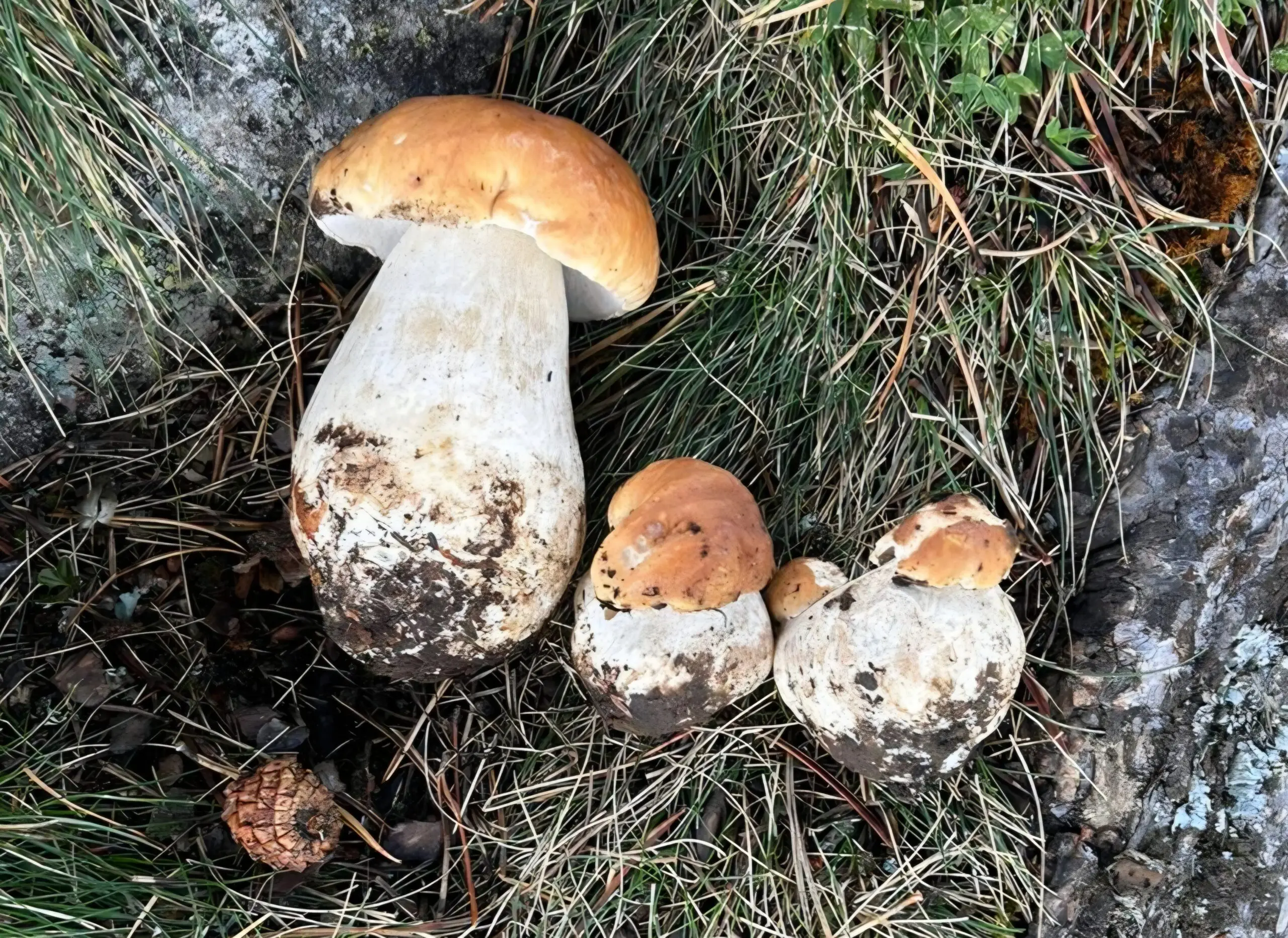
The cep — known in Britain as the penny bun, and internationally as porcini (Boletus edulis and its close relatives in the same group) — is a fungus in the Boletaceae family, with a brown-to-orange cap and a stocky white stem, often finely netted. It isn’t a plant but a fungus: it lives in obligate symbiosis with the roots of certain trees (oak, beech and pine among them). It fruits mainly in autumn, after a spell of rain followed by milder days.
Included here as an exception to our usual scope: not a plant, but a find close enough to the ground and the woodland edges that border Mediterranean gardens to earn its place.
Reliable pointers before you go looking
The fungus and its symbiosis
The cep is recognised by its brown-to-orange cap, domed, smooth and often glossy in damp weather, its stocky white stem, swollen at the base and finely netted, and its white-to-yellow-green pores under the cap (never gills). « Cep group » or « porcini group » covers several very close, all-edible species — Boletus edulis, B. aereus (darker cap, under oaks), B. pinophilus (more reddish cap, under pines), B. aestivalis (fruits earlier) — which foragers rarely tell apart in the field and lump together under one name.
Why you can’t « grow » a cep
A cultivated mushroom (oyster, button) is grown on straw or sawdust because it feeds on dead organic matter. The cep does the opposite: it is ectomycorrhizal, its mycelium partners with the fine roots of a living tree, trading water and minerals for sugars. That symbiosis is still poorly reproduced under controlled conditions, despite long-standing attempts. Inoculation kits exist commercially (mycelium placed near a compatible tree’s roots), but they guarantee nothing: when it takes at all, it usually takes several years, with no certainty of fruiting.
| What you might expect | Reality | Why — and the trade-off |
|---|---|---|
| A guaranteed harvest | Impossible with the cep | Root symbiosis can’t be steered like a conventional crop. |
| Trying inoculation | Commercial mycelium kits | Uncertain take, several years’ wait. ⚠️ no guarantee of fruiting. |
| Worth remembering | Observe rather than plan | The cep stays a find tied to the year’s conditions and a tree already in place. |
When to hope for a flush
No planting calendar here: just a fruiting window, triggered by the weather more than the civil calendar.
| Jan | Feb | Mar | Apr | May | Jun | Jul | Aug | Sep | Oct | Nov | Dec | |
|---|---|---|---|---|---|---|---|---|---|---|---|---|
| Fruiting window |
You don’t grow the cep: you welcome it. On an estate where most things are managed — watering, pruning, timing — the cep remains the exception that escapes every method. Some years, after the right spell of rain, the surprise turns up near a tree already in place; other years, nothing. That is precisely what makes it a find rather than a harvest.
Behaviour, mechanism and limits
The cep never grows apart from its tree: without a compatible host close to the roots, no fruiting is possible, whatever the weather. That’s the first limit to know before you even start looking.
The mechanism that triggers a flush is specific: enough rainfall (roughly 30-50 mm) over about a week, followed by a return to drier weather and a favourable soil temperature. This trigger explains why two neighbouring years can give an abundant harvest, then nothing at all — the variable isn’t the location, which doesn’t change, but that autumn’s weather sequence.
Another real, non-negotiable limit: no identification by photo or description replaces a direct, in-hand check. The edible cep group can occasionally be confused with bitter boletes or, more rarely, with species that should not be eaten. In the UK, several local fungus groups and county mycological societies offer identification help; when in doubt, that is the safe route before eating anything.
Looking without getting it wrong
The last 10 days’ weather
Marked rain followed by a few drier, milder days is the signal to watch, not the calendar.
The tree before the fungus
Spot the host species first (oak, beech, pine, sweet chestnut): without them, looking elsewhere is pointless.
Cut, don’t pull
Cutting at the base with a knife leaves the mycelium in place for a possible later flush.
Check before eating
Have the haul checked by a local fungus group or mycological society: no exceptions, even for an experienced forager.
What should stop you picking
The edible cep group is relatively easy to recognise (pores not gills, flesh that doesn’t bruise strongly, netted stem), but certain signs should make you stop.
| What you see | Interpretation | Cautious action |
|---|---|---|
| Flesh that bruises strongly blue or red when cut | Suggests a bolete to avoid, outside the classic cep group | Don’t pick, or have it checked at the first doubt |
| Bright red or orange pores under the cap | A character absent from the usual edible cep group | Discard as a precaution |
| Flesh very bitter on tasting a small raw fragment | Bitter bolete (Tylopilus felleus), not toxic but inedible | Don’t cook the batch, sort again |
| Old specimen, soft flesh, greenish spongy tubes | Over-mature, hard to digest even if the species is good | Leave it in place, only take firm specimens |
| Any doubt about identification | Possible confusion with a non-edible species | Check with a local fungus group or mycological society before eating |
This table replaces no professional check. If in doubt, don’t eat it, and get it checked.
The law, in brief
In England and Wales, picking wild fungi on public land for personal use is not theft under the Theft Act 1968 — but foraging in National Nature Reserves or Sites of Special Scientific Interest without permission is an offence under the Wildlife and Countryside Act, picking on private land needs the landowner’s consent, and picking in commercial quantities for resale requires a permit. The penny bun grows under oak, beech and pine from late summer through autumn, and is one of Britain’s most prized wild edibles.
One find, so far, in autumn, under pines
On our estate, a single cep find has happened to date, under pines — consistent with the pine bolete (Boletus pinophilus), though the exact species was never determined with certainty. Our land actually has two rainy seasons, spring and autumn alike; but this one find came in autumn, never yet in spring — a single case proves no rule, only that here, the one time it happened, it was autumn that paid off. We did not have that harvest checked by a fungus expert or mycological society before eating it: we relied on the usual characters — pores, netted stem, flesh that doesn’t bruise — on a group widely considered among the safest to recognise. That isn’t what we recommend: it’s the comfort of a recognition already practised on other finds, not a method to follow without it. For anyone without that experience, a professional check remains the only reliable safeguard.
Simple, so as not to mask the flavour
Fresh ceps are best prepared simply: pan-fried raw in a little fat over high heat to sear without stewing, garlic and parsley added right at the end. It’s also a mushroom that dries very well (thin slices, slow drying) to flavour dishes out of season — a way to make an unpredictable harvest last.
Species in the group worth knowing
| Species | Useful characters | Typical habitat |
|---|---|---|
| Boletus edulis (penny bun / cep) | Brown to hazel cap, the most widespread of the group | Broadleaf and conifer woodland, wide range |
| Boletus aereus (dark cep) | Very dark brown cap, firm flesh | Under oaks, warm ground |
| Boletus pinophilus (pine bolete) | Reddish to chestnut-brown cap, stocky stem | Under pines, often upland |
| Boletus aestivalis (summer cep) | Paler cap, fruits earlier | Broadleaf woodland, from late spring |
What people ask most
Can I grow ceps in my garden?
Not reliably. It’s a mycorrhizal fungus, partnered with a living tree’s roots: inoculation kits exist but guarantee neither the take nor fruiting, often after several years’ wait.
How long after rain does a cep appear?
Allow 3-7 days lowland, 7-10 days upland, after a sufficient spell of rain (around 30-50 mm) followed by drier weather.
How can I be sure I have a real cep and not a species to avoid?
Check for pores (never gills), a netted stem, and flesh that doesn’t bruise strongly. If in doubt, checking with a local fungus group or mycological society remains the only reliable safeguard.
Is it legal to pick wild mushrooms in the UK?
Yes, on public land for personal use, under the Theft Act 1968. Picking in protected nature reserves without permission, on private land without consent, or in commercial quantities without a permit is not covered by that right.
Sources and verification
Last checked: 27 August 2026.
- Wild Food UK — Foraging Code: legal basis for picking wild fungi, personal-use limits.
- Fungi Atlas — Mushroom hunting in the UK: species, foraging law, protected sites.
- Kew Science — Plants of the World Online: taxonomic reference.