Glossy Abelia
Abelia, mainly Abelia × grandiflora in gardens
A supple, long-flowering shrub, invaluable for lightening a low hedge, a shrub border or a large pot. Its success owes less to the variety name than to three settings: drainage, light and measured pruning.
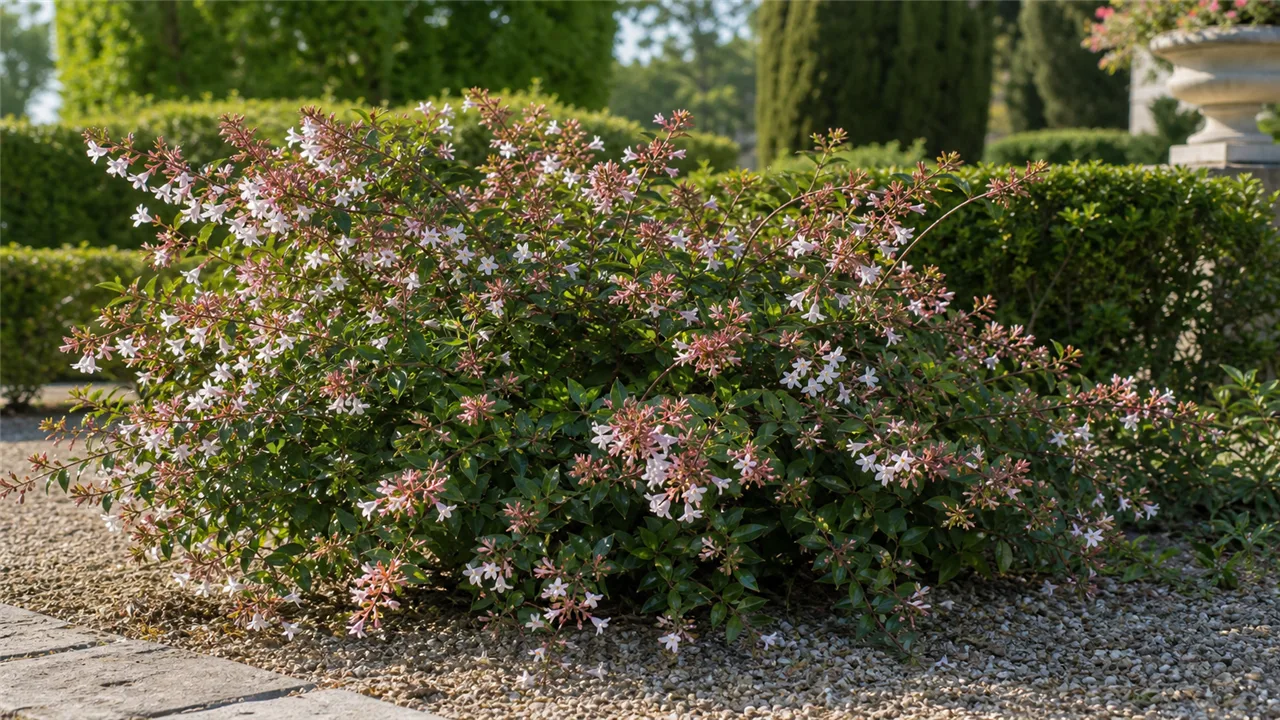
Abelia is a shrub for gentle sun or light partial shade, planted in drained soil that never stays waterlogged. It flowers for a long season, from summer into autumn depending on climate and variety, and needs little pruning: a light thinning in late winter is usually enough to keep its arching outline and its bloom.
To move around the encyclopedia, compare it with other structural shrubs such as the Mexican orange blossom, the photinia or the deutzia. Abelia stands out for its long flowering and its softer, more transparent silhouette.
The reliable markers for choosing an abelia
Where should you plant an abelia so it truly flowers?
Plant abelia in clear but not scorching light: morning sun, dappled sun, a bright border, the shelter of a warm wall. The NC State Extension Gardener Plant Toolbox confirms that Abelia × grandiflora accepts full sun to partial shade, with better flowering in sun.
The second criterion is drainage. An established abelia tolerates moderate drought, but it resents suffocating ground. In a clay garden, plant slightly raised, work in mature organic matter and avoid the hollow that holds water through winter.
The third criterion is the scene. In a low hedge, abelia keeps a transparency that photinia does not always have. In a border it sits well beside the crisper flowers of the deutzia or the rounded volumes of the viburnum. In a pot it wants a stable container, a free-drainingDescribes soil that lets water flow away easily, without pooling around the roots. mix and steady watering in the first season.
When to plant, prune and enjoy an abelia
This calendar stays deliberately practical: it favours the gestures that change the result in the Châtelain’s garden. In cold or windy areas, shift planting towards spring and protect young plants through the first winter.
| Jan | Feb | Mar | Apr | May | Jun | Jul | Aug | Sep | Oct | Nov | Dec | |
|---|---|---|---|---|---|---|---|---|---|---|---|---|
| Plant | ||||||||||||
| Light prune | ||||||||||||
| Flowering | ||||||||||||
| Establishment watering |
How to decide before buying an abelia
Read the light
Count the hours of useful sun. The less light the scene receives, the more you must accept an open silhouette and a quieter bloom.
Test the drainage
After rain, water should drain away quickly. If the soil stays shiny and sticky, plant on a low mound or choose another shrub.
Choose the right volume
A compact abelia suits a pot or an edge. A 1.5 m form structures a loose hedge or an entrance border more convincingly.
Preserve the habit
Prune to open and rejuvenate, not to manufacture a ball. The plant should keep the arching stems that make all its charm.
How to prune an abelia without losing its elegance
Abelia flowers on the current season’s growth, so pruning in late winter or the very start of spring limits the risk of cutting off the bloom. The idea is not to cut everything back each year, but to remove dead wood, weak shoots and a few of the oldest branches if the base opens up.
If the abelia looks like a compact ball, it has usually been sheared too hard. If you can make out supple stems, light gaps and flowers around the edge, the pruning is serving the scene instead of constraining it.
On an old specimen, rejuvenate in stages: take out about a third of the oldest stems at the base, then let the plant make young wood again. A hard cut is possible, but it changes the outline for a season; keep it for shrubs that are genuinely bare at the base.
Which abelia varieties to choose by use
A short selection: the forms below help you understand the uses, without turning the page into a catalogue. Heights are indicative, as soil, pruning and climate strongly change the volume.
| Form to know | Main interest | Recommended use |
|---|---|---|
| Abelia chinensis | Pink-white flowering, botanical and natural appeal, fragrant | Sheltered border, loose scene |
| Abelia × grandiflora | The garden classic, semi-evergreenDescribes foliage that stays on the plant all year, even in winter. to evergreen in mild climates | Loose hedge, border, gentle bank |
| Abelia ‘Edward Goucher’ | Lilac-pink flowers, more compact habit | Flowering edge, small garden |
| Abelia × grandiflora ‘Kaleidoscope’ | Bright variegated foliage, contained size | Pot, terrace, front of border |
| Abelia × grandiflora ‘Confetti’ | Cream-variegated foliage, light effect | Bright border, refined edge |
| Abelia × grandiflora ‘Little Richard’ | Dwarf habit, small white flowers | Low edge, terrace |
| Abelia × grandiflora ‘Prostrata’ | More spreading habit, ground-cover effect | Bank, front of border |
Why does an abelia yellow, flower little or go bare?
Yellowing foliage often signals excess water, compacted soil or a difficult root establishment. Before adding fertiliser, check the planting pit, the watering frequency and the drainage. In a pot, the drainage hole matters as much as the compost.
Weak flowering usually comes from three causes: too little light, over-mechanical shearing, or a still-young shrub. If the plant grows but does not flower, ease off the shears and let the stems form new shoots.
An abelia going bare at the base is not necessarily lost. Rejuvenate it in stages, mulchA layer of material (bark, straw…) laid on soil to retain moisture and limit weeds. modestly and keep the soil fresh for the first year after cutting. In a mixed hedge, alternate it with denser shrubs, for example a viburnum or a Mexican orange blossom, to keep structure even in winter.
The right abelia is not the one that promises the most flowers on the label. It is the one whose mature volume, local hardinessA plant's ability to survive winter cold without protection. and pruning style match the scene. In a garden of character, we let it breathe: its grace comes from its stems, not from a cut to the line.
– Les Jardins d’un Châtelain
Frequently asked questions about abelia
Where should I place an abelia in the garden?
Place it in gentle sun or light partial shade, in drained soil. It flowers better with several hours of direct light, but appreciates a sheltered spot in cold or windy regions.
When should I prune an abelia?
Prune lightly in late winter or early spring, before strong regrowth. Focus on dead wood, crossing branches and a few old stems if the shrub goes bare.
Can you grow an abelia in a pot?
Yes, especially compact forms such as ‘Kaleidoscope’, ‘Confetti’, ‘Little Richard’ or ‘Prostrata’. Use a large, stable container, a free-draining mix and regular watering while it establishes.
Does abelia keep its leaves in winter?
It can stay evergreen or semi-evergreen in mild climates, but becomes deciduousDescribes foliage that falls in autumn and regrows in spring. or drops part of its leaves in cold ones. This behaviour depends on the variety, wind, frost and the age of the plant.
Which shrub goes well with abelia in a low hedge?
Pair it with shrubs that add a different density: Mexican orange blossom for fragrant foliage, viburnum for structure, deutzia for spring flowering, or photinia if you want a more emphatic hedge.
Sources and editorial control
- NC State Extension Gardener Plant Toolbox – Abelia × grandiflora: exposure, soil, flowering on the current year’s wood, hardiness and uses.
- Kew Science, Plants of the World Online – Abelia chinensis: taxonomic frame, family Caprifoliaceae and native range.
- Gardening Know How – When and how to prune an abelia: practical cross-check on pruning timing and renewal.