Decking on Pedestals: Build a Terrace Without a Concrete Slab
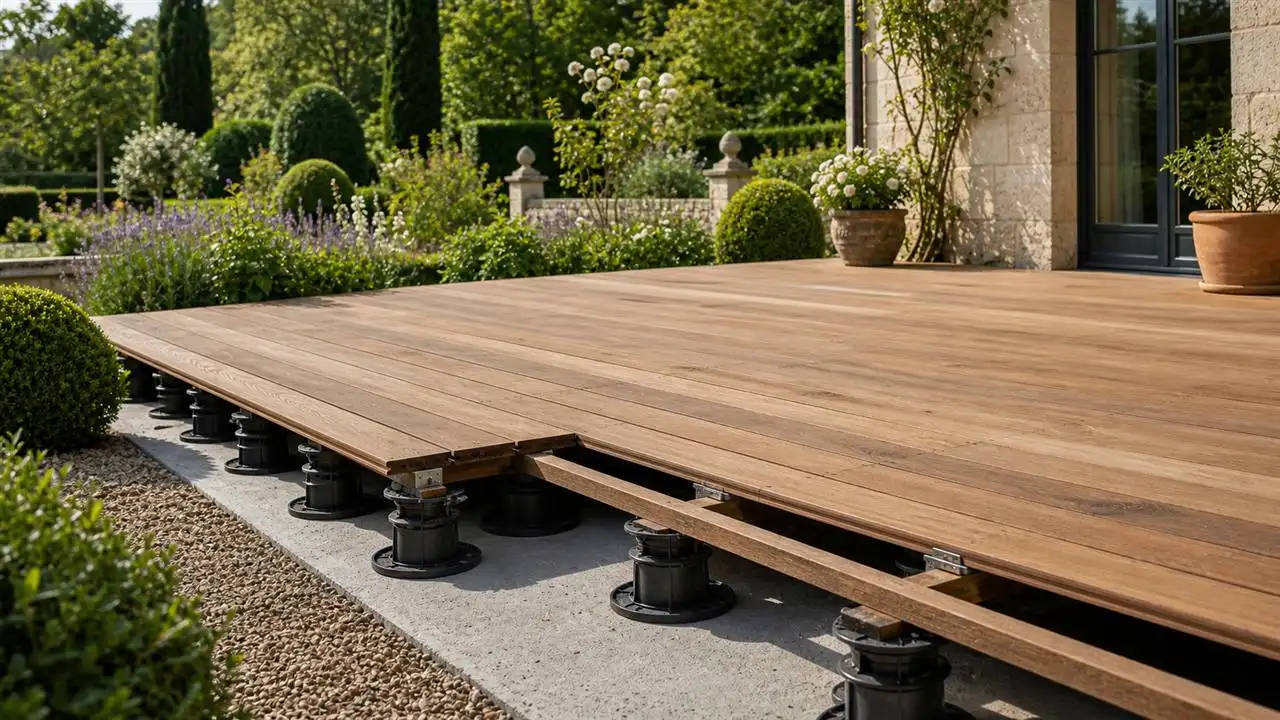
Decking on pedestals is built without a concrete slab: adjustable pedestals support tiles or joists, levelling out the ground and letting water drain freely beneath. Quick, reversible and ideal for renovation, it works with paving, timber and composite alike. Here’s how to plan and build it.
The Chatelain Method for decking on pedestals
You observe the support (existing slab, gravel, waterproofing) and the fall; you diagnose the right pedestal and covering type; you correct levels through adjustment; you prevent problems with good drainage beneath the deck.
Why choose pedestals?
| Strength | Detail |
|---|---|
| No concrete | Dry, clean, quick installation |
| Levels corrected | Height-adjustable pedestals |
| Drainage | Water flows freely underneath |
| Reversible | Access to services, removable deck |
The Chatelain note. The adjustable pedestal is the key: it corrects slopes and guarantees a perfectly level deck over uneven ground, with no screed needed. Aim for a slight drainage fall (around 1%) in the support beneath the pedestals.
Installation steps
- Prepare the support: slab, waterproofing, or a well-draining stabilised gravel bed.
- Space the pedestals according to the joist or tile spacing.
- Adjust the height pedestal by pedestal, with a straight edge and spirit level.
- Lay tiles (on head pedestals) or boards on joists over pedestals (timber deck).
What decking on pedestals forgives, and what it doesn’t
Decking on pedestals feels deceptively easy: no concrete slab, no groundwork, millimetre-precise adjustment. But it doesn’t forgive a poorly prepared support. Pedestals correct height — they don’t stabilise soft ground, replace drainage, or fix an undersized structure.
In a well-kept garden, a terrace is a threshold. It should connect house and garden, not just offer a flat surface. Its level, orientation, width and the way water escapes beneath the boards matter as much as the visible material.
| Element | Requirement | Consequence if ignored |
|---|---|---|
| Support | Stable, draining, compacted | Localised sinking |
| Fall | Drainage planned beneath the deck | Standing water |
| Spacing | Matched to tiles/joists | Flex, noise, cracking |
| Access | Hatches or removability | Services unreachable |
The right approach is to adjust the pedestals only after thinking through where the water goes. A perfectly flat deck on the surface can still fail if water gets trapped underneath.
The final call: pedestals or a concrete slab?
Pedestals excel in renovation, on a stable support, when you want a reversible, draining, adjustable installation. A concrete slab still makes sense on very unstable ground, under heavy loads, or for a permanent mineral structure.
It’s not an ideological choice. Decking on pedestals succeeds when the support is sound and water can move freely. If you’re stacking ever-taller pedestals to compensate for poor ground, you’re not simplifying the job — you’re just relocating the problem.
FAQ
Can decking on pedestals be laid on bare soil?
Not directly: a stable, draining support (compacted gravel with geotextile) is needed, or the pedestals will sink.
What height range do pedestals cover?
Adjustable pedestals typically cover a few centimetres up to several tens of centimetres, depending on how much levelling is needed.
Decking on pedestals: tiles or timber?
Either: tiles on head pedestals, or timber/composite boards on joists set on pedestals. The choice depends on style and desired maintenance.
Is decking on pedestals solid?
Yes, provided you respect the recommended pedestal spacing for the covering and set the levels correctly.