Choose a Garden Shed: Material, Size and Permissions
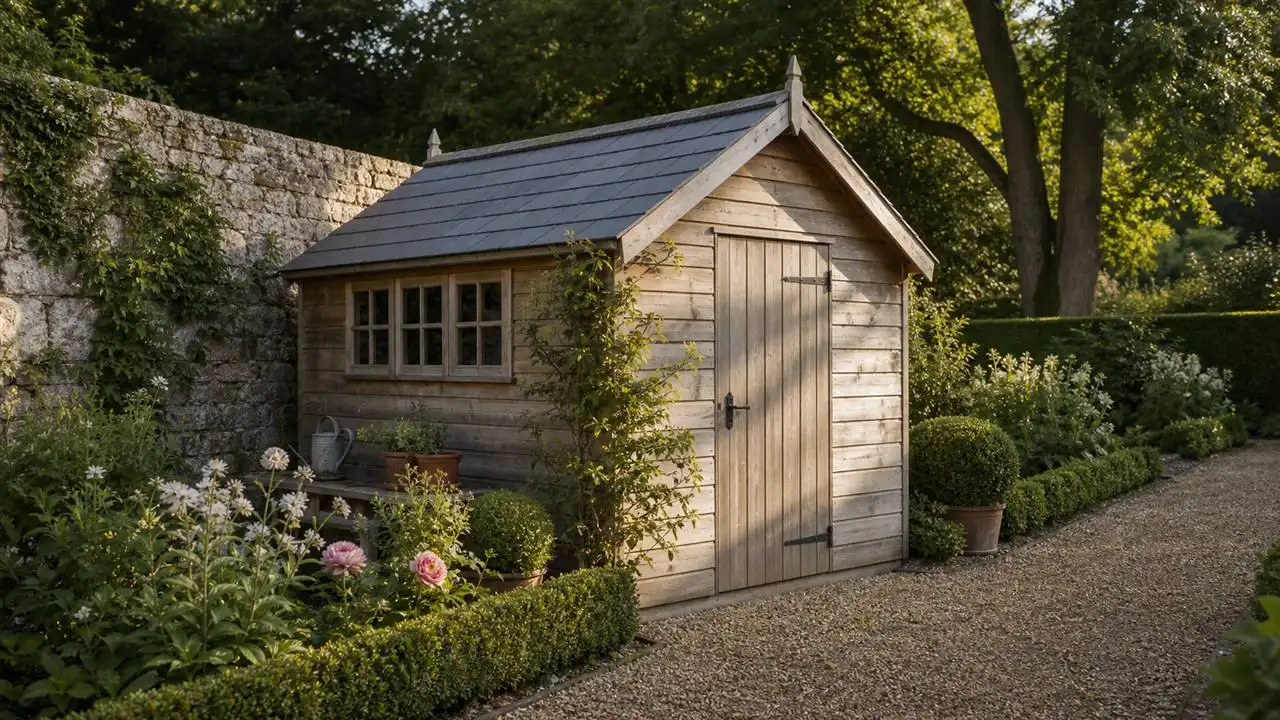
Choosing a garden shed means weighing up wood (warm, needs upkeep), metal (durable, budget-friendly) and resin/plastic (maintenance-free). In England, there’s no fixed maximum size under planning law itself, but permitted development rights only cover it if you stay within height limits and the 50% garden coverage rule. Good ground preparation guarantees longevity. Here’s how to decide.
The Chatelain Method for a garden shed
You observe the use (storage, workshop, bikes) and the site; you diagnose the right material and size; you correct with a sound base; you prevent admin headaches by checking the rules before you buy.
Wood, metal or resin?
| Material | Strengths | Limits |
|---|---|---|
| Wood | Attractive, insulating, repairable | Needs maintenance (treatment/stain) |
| Metal | Robust, economical, low maintenance | Condensation, less homely |
| Resin/plastic | Zero maintenance, lightweight | Plasticky look, less sturdy |
The Chatelain checklist. In England, permitted development generally allows a shed without planning permission provided: eaves height stays under 2.5m, overall height under 4m (dual-pitch roof) or 3m (other roofs), it’s not forward of the house’s front wall, and — combined with any other outbuildings and extensions — it doesn’t cover more than 50% of the garden. Within 2m of a boundary, overall height must stay under 2.5m. Rules differ in Scotland, Wales, Northern Ireland, and for listed buildings — check with your local council.
Preparing the ground and installing
A shed needs a flat, well-drained base: a concrete slab, paving on a gravel bed, or deck blocks. Avoid direct contact between wood and damp ground. Take care with anchoring against wind and with ventilation to limit condensation.
A shed should disappear without looking cheap
In a well-kept garden, the shed is rarely the glamorous subject. Yet it can ruin a view faster than a badly chosen plant. Too visible, too pale, too metallic, and it draws the eye like a mistake. Well chosen, it becomes a discreet outbuilding: useful, stable, almost unnoticed.
Before buying, settle these points:
| Question | Useful answer | Common mistake |
|---|---|---|
| What must it hold? | A precise tool list | Size picked at random |
| Where is it seen from? | From the house and paths | Purely practical siting |
| Which material ages well? | Maintained wood or discreet metal | Overly glossy PVC |
| What base? | Stable, ventilated ground | Direct placement on soil |
FAQ
Do I need planning permission for a garden shed?
Often not, under permitted development, but height limits and the 50% garden coverage rule apply, and rules vary across the UK. Check with your local council, especially near a boundary or on a listed property.
Wood or metal shed: which to choose?
Wood for looks and insulation (with upkeep); metal for robustness and maintenance-free budget value. Resin for zero maintenance.
Do I need a concrete slab?
Not necessarily: deck blocks or paving on a gravel bed often suffice, provided the ground is flat and well-drained.
How do I avoid condensation in a metal shed?
Ensure good ventilation and, if needed, light insulation or an anti-condensation layer under the roof.