Japanese Stone Lantern in the Garden: Placement, Granite and Mistakes
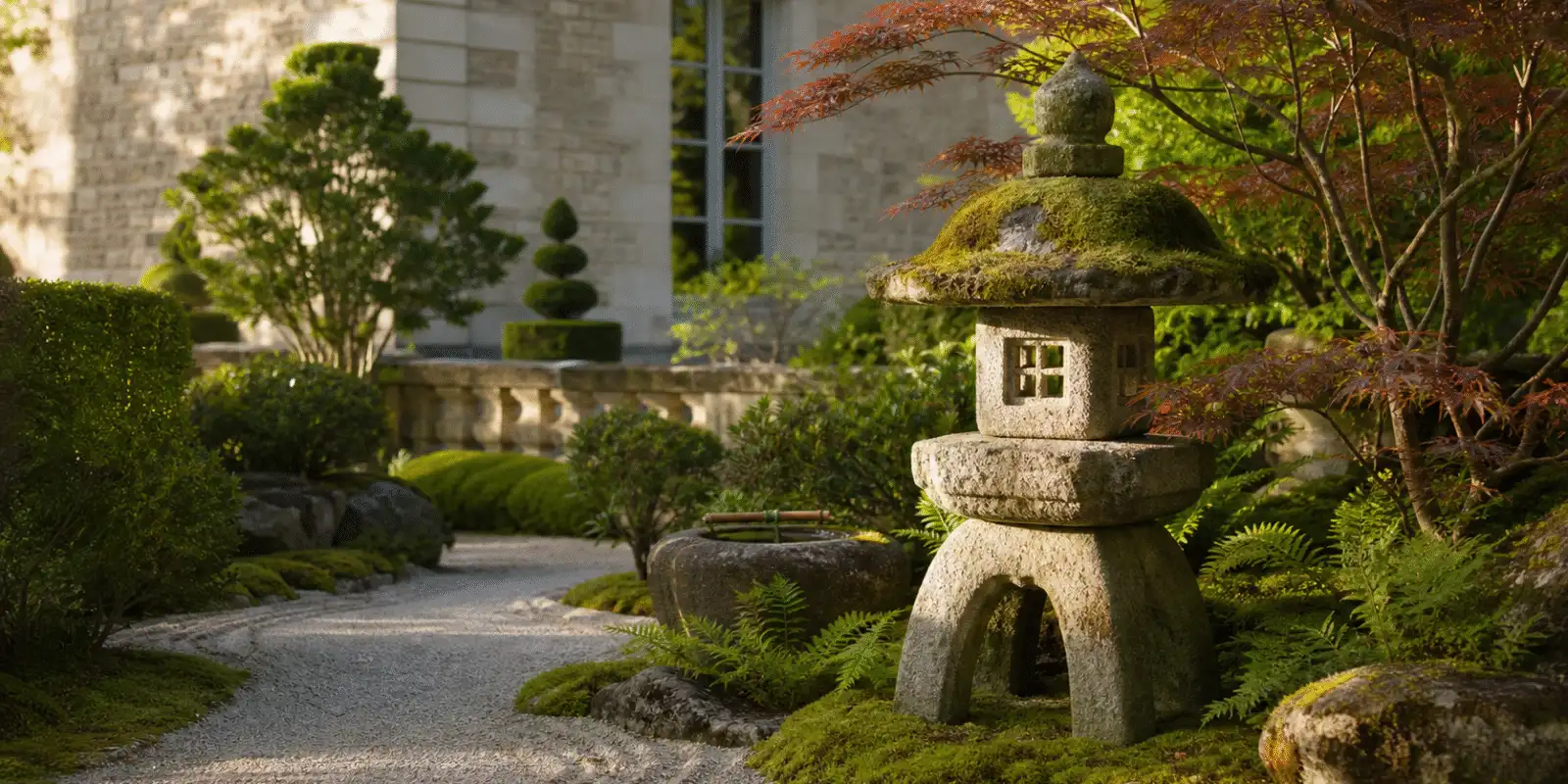
A Japanese stone lantern works best as a sign, not a trinket: beside a path, water edge, threshold or low planting. Choose stable stone, keep proportions quiet and give it space. For the planting mood, pair it with drought-resistant, restrained plants.
The search query is popular because the object is instantly recognisable. The difficulty is restraint. Too centred, too bright or too new, a lantern becomes scenery rather than atmosphere.
The Japanese word tōrō refers to a traditional lantern used in temples and gardens. In a European garden, the lesson is not to copy a postcard, but to borrow the grammar of pause, stone and shadow.
The Chatelain Method
Observe the viewing axis, diagnose the garden’s resting point, correct scale with low planting, and prevent the theme-park effect. A successful lantern is noticed on the second look; it supports a scene rather than demanding one.
Which Japanese lantern type fits where?
| Type | Best position | Effect |
|---|---|---|
| Yukimi | Near water or a low bank | Horizontal, calm, contemplative. |
| Kasuga | Path entrance or threshold | More vertical and ceremonial. |
| Small path lantern | Low border or path bend | Discreet signal at seated eye level. |
| Very tall lantern | Large structured garden only | Avoid in small spaces, where it dominates. |
Where should you place it without making the garden look staged?
The best position is rarely the middle of a lawn. Place the lantern where the garden changes rhythm: water edge, path start, terrace threshold, border corner or beneath a small tree.
In the aesthetics of the Japanese garden, asymmetry, emptiness and suggestion matter as much as the object. A lantern slightly off-axis and brushed by foliage often feels more authentic than one displayed in a gravel circle.
- Avoid the geometric centre of an empty area.
- Leave at least one side open and breathable.
- Orient it toward movement or water, not only toward the house.
Granite, cast stone or concrete: which is best?
Granite ages beautifully, resists frost and keeps a serious mineral presence. Cast stone can work in a smaller garden, but it benefits from weathering and planting. Very smooth concrete often feels too theatrical.
Weight is a virtue. A lighter lantern tips, sounds hollow and needs too much staging. A smaller, heavier piece on compacted gravel is better than a tall unstable one.
Should a Japanese lantern be lit?
Yes, but barely. A visible bulb turns the lantern into a garden bollard. Use a warm, low-voltage, hidden source if you want evening presence without losing the poetry of the stone.
When shade and coolness are already part of the design, the lantern becomes a night marker. It can belong near a pond, pergola or seating area, alongside ideas from our guide to shade sails and cool garden spaces.
Which plants frame a Japanese lantern well?
Keep the base readable. Moss works in suitable climates; otherwise use low ferns, fine grasses, ophiopogon, carex, clipped lavender or creeping thyme according to exposure.
Our practical proportion is one third mineral, one third low planting and one third empty space. That empty space is what gives the lantern dignity.
Compose the scene before setting the stone
Before acting, treat the Japanese stone lantern as part of the garden composition, not as a stand-alone purchase. In practical terms, mock up its volume with a bucket or crate before moving the stone. This small pause prevents visible corrections once the garden is already finished.
The main risk is a piece that is too central, too bright or staged like a decorative prop. In a refined garden, that mistake remains visible for a long time: it costs time, weakens the scene and often forces repairs when conditions are least convenient.
For timing, keep this marker in mind: judge it in spring and summer, when foliage truly changes the scale. If one point still feels uncertain, wait a few days, watch the weather and check that the chosen solution will remain easy to maintain, not merely attractive on paper.
Keep a simple record of the decision: three photos from the path, terrace and water edge before final installation. It helps later when ordering compatible material, understanding what was done or adjusting maintenance without starting the diagnosis from scratch.
Finally, check that the suggested gear truly supports the action described in the article. The buying block should help the work, not add a decorative or fragile accessory that makes maintenance harder.
The Chatelain rule is simple: a good garden solution must still look clear, maintainable and proportionate six months after installation. If it fails that test, it needs one more adjustment.
- Mock up the volume first.
- Check three viewing axes.
- Bury the base slightly.
- Leave empty space around the stone.
- Keep lighting very soft.
FAQ
What size Japanese lantern suits a terrace?
Often 40 to 80 cm high. Larger pieces can dominate the terrace instead of supporting it.
Can a Japanese lantern work in a modern garden?
Yes, if the composition stays restrained: stone, grasses, water or gravel, without piling up symbols.
Should the lantern be perfectly straight?
It must be stable, but not stiff. Slight integration into planting usually feels more natural than a showy plinth.
Related Reading
Useful Sources
Written and checked by the editorial team of Les Jardins d’un Chatelain.