Japanese maple
Acer palmatum
A tree of changing light, from spring emergence to autumn colour. Success depends less on feeding than on three compatible choices: a cultivarA variety produced through selection or cultivation, distinct from the wild original plant. that fits the space, a sheltered position and a rootballThe block of soil left around a plant's roots when it is planted or moved. that stays moist without sitting wet.
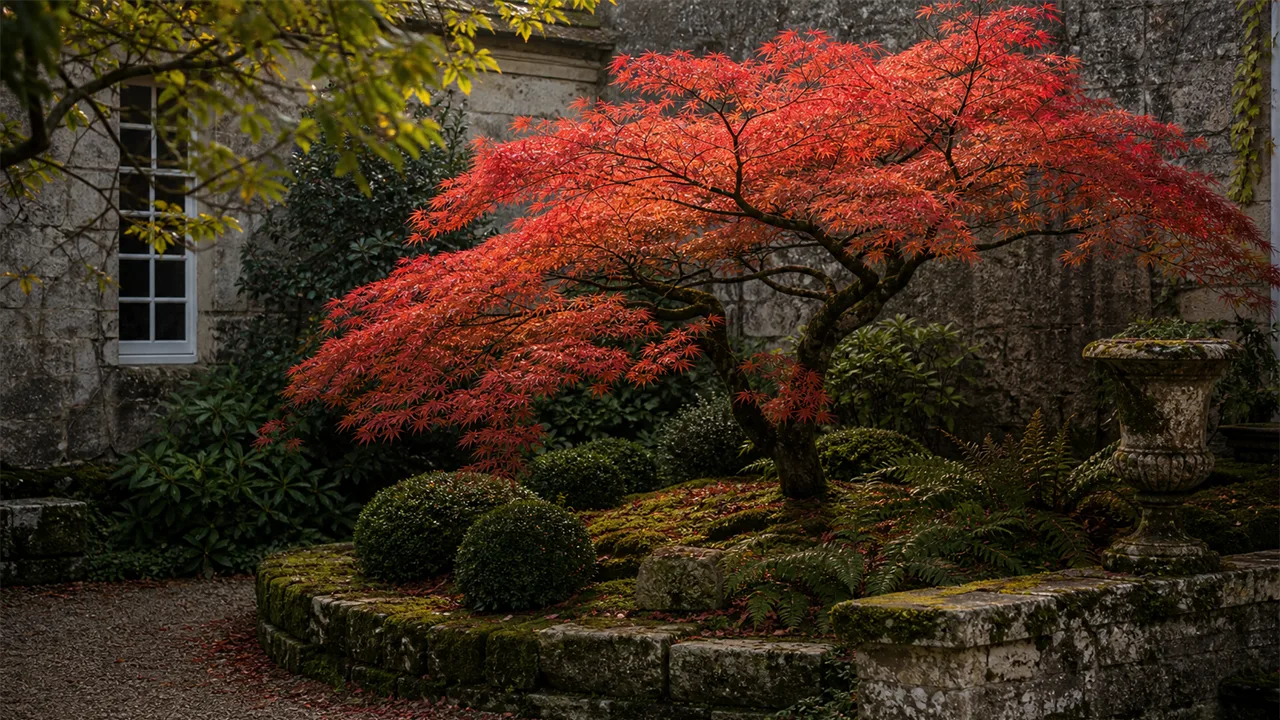
A Japanese maple should not be watered by calendar alone. The right decision comes from plant stage, moisture actually present in the rootball, rain and exposureThe amount of sunlight a spot in the garden receives (full sun, part shade, shade). to sun or wind. Its fine leaves reveal imbalance quickly, but brown margins do not automatically mean disease or a need for fertiliser.
For a layered part-shade planting, compare it with hydrangea and rose, then browse every species in the plant encyclopedia.
Reliable facts before choosing
Where can a Japanese maple grow without scorching?
The RHS recommends a cool, lightly shaded spot sheltered from strong winds. Morning sun or filtered light develops colour without the full burden of afternoon heat. A red-leaved cultivar may lose intensity in deep shade; a finely dissected form is more prone to scorch and deserves greater protection.
Well drained does not mean dry. The aim is a soil that holds some moisture while allowing surplus water to escape. Do not bury the main roots deeply: the RHS advises no more than 2.5cm of soil above them. Leave room for the shallow root system rather than planting dense competition at once.
When should you plant, monitor water, feed and prune?
This is a temperate-climate guide. Shift work with local budbreak and do not plant or feed into frozen, saturated, hot or drought-stressed soil.
| Jan | Feb | Mar | Apr | May | Jun | Jul | Aug | Sep | Oct | Nov | Dec | |
|---|---|---|---|---|---|---|---|---|---|---|---|---|
| Plant | ||||||||||||
| Check the rootball | ||||||||||||
| Feed only if justified | ||||||||||||
| Minimal pruning | ||||||||||||
| Inspect leaves and shoots |
How much water does a Japanese maple need in soil or a pot?
First year in the ground. Before adding water, push your fingers roughly 5cm into the backfill around the rootball. If it is dry at that depth, water slowly over the rootball and just beyond it; if it is still moist, wait. Repeat the test after rain: deduct only rainfall that has actually wetted the rooting zone.
For a newly planted Japanese maple in Kansas, K-State Research and Extension gives a benchmark of at least 10 US gallons per week, about 38 litres, delivered slowly during the first year. This foreign benchmark is not an automatic UK dose and does not apply to a small pot. The 5cm moisture check always takes priority. In heavy soil that remains moist, add nothing and examine drainage; in very free-drainingDescribes soil that lets water flow away easily, without pooling around the roots. soil or drying wind, check more often without inventing a fixed dose.
Established in the ground. The RHS says to water in summer if needed. Look for the root zoneThe area of soil occupied by a plant's roots, where water and nutrients matter most. beginning to dry, then soak slowly and deeply instead of applying a small daily sprinkle. Brown leaf edges during a hot, sunny or windy spell point to increased demand, but saturated roots can produce a related water-uptake problem.
In a container. Keep the compost moist but not soaking wet, allowing it to begin drying between waterings without letting the rootball dry completely. In hot weather, the RHS notes that a daily check may lead to daily watering. Wet the compost thoroughly, let it drain and never leave the pot standing in a full saucer.
Which NPK should be used, and when?
The robust technical sources consulted do not establish a universal NPKThe three main nutrients in a fertiliser: nitrogen, phosphorus and potassium. ratio specific to Acer palmatum. Presenting 10-10-10 or another grade as the species recipe would therefore be misleading. The RHS says established trees in the ground do not need feeding. Mature organic mulchA layer of material (bark, straw…) laid on soil to retain moisture and limit weeds. can improve soil structure and reduce moisture loss, but it is not a substitute for diagnosing a deficiency; keep it clear of the trunk.
Do not fertilise during the first growing season. This is K-State’s direct recommendation for Japanese maples. From the following year, only where analysis or genuinely poor growth supports an application, their timing is early spring before the leaves emerge. Use the ratio recommended by the analysis and a locally authorised product, following its label. Virginia Tech and Berlin plant-health guidance both warn against excessive nitrogen in relation to Verticillium risk.
A tree kept in the same container for more than a year may benefit from a general-purpose granular feed in late spring according to the RHS. Its formulation and dose still come from the product label and the compost’s condition, not an invented ratio. Do not feed a dry, saturated, scorched or declining rootball: correct water, drainage and exposure first.
Four checks before making a correction
Name the stage
Record whether the tree was planted this year, is established in the ground or grows in a pot. The same brown edge does not lead to the same watering decision.
Read the rootball, not weather alone
Check soil at about 5cm and record rain that infiltrated, wind and exposure. Water only when the zone starts to dry.
Compare symptoms
Evenly scorched margins suggest stress; one-sided wilt with shoot dieback calls for investigation of a vascular cause.
Change one variable
Move a pot, correct watering or obtain a diagnosis, then date the response. Avoid adding water, feed and treatment simultaneously.
Scorch, Verticillium, a pest or tar spot?
Several problems cause brown leaves or wilt. Use at least two matching signs; if a whole sector declines, seek confirmation before treating or replanting.
| Observed sign | Possible cause | Useful distinction | First action |
|---|---|---|---|
| Brown tips and margins, leaves curling and becoming crisp, especially after strong sun or wind. | Physiological leaf scorch | The RHS links scorch to leaves losing water faster than roots can take it up; drought, waterlogging, frost, wind and hot sun can all contribute. | Check moisture and drainage, shelter from midday sun and wind, and move a pot if needed. Do not add fertiliser or fungicide automatically. |
| Wilt or dieback begins on one branch or one side, with dull foliage; green-brown arcs or rings may occur in the wood. | Verticillium wilt Verticillium spp. | Sectoral symptoms and vascular staining are clues, but staining can be absent or patchy; laboratory diagnosis remains the reliable confirmation. | Avoid excessive nitrogen, prune dead wood with cleaned tools and obtain a diagnosis. No documented cure exists. |
| Colonies beneath leaves, honeydew, fixed shields, chewed foliage or small galls. | Aphids, scales, caterpillars or Acer gall mite | The organism or damage pattern matters more than discolouration alone. | Photograph and identify the organism; use physical removal for a light infestation where practical. Check any biological or pesticide option against the current local register. |
| A container tree declines with roots eaten; adult feeding notches may appear on leaves. | Vine weevil | The RHS particularly flags larvae feeding on roots of container-grown Japanese maples. | Ease the plant from its pot and inspect the rootball to confirm larvae before acting. |
| Large pale or yellow spots become glossy black and tar-like on the upper leaf surface in summer. | Tar spot Rhytisma acerinum | INRAE records spots several centimetres wide; the disease is common and usually minor outside nurseries. | Collect affected fallen leaves. Do not confuse localised black spots with evenly scorched margins. |
Which form fits the available space?
These are RHS maturity bands and actual size varies with soil, climate and training. Always check the botanical label of the plant offered.
| Cultivar or group | Habit and reference size | Main feature | Watch point |
|---|---|---|---|
| ‘Bloodgood’ | Bushy, about 2.5–4m | Deep red-purple leaves, red in autumn. | Allow for its width and enough light to hold the colour. |
| ‘Orange Dream’ | Bushy, about 2.5–4m | Yellow in spring, green in summer, orange-yellow in autumn. | Filtered light reduces scorch on young leaves. |
| Dissectum Group | Low and spreading, about 1.5–2.5m | Finely divided foliage and a mound-like or weeping outline. | Very finely cut leaves are particularly exposed to drying wind and strong sun. |
| ‘Sango-kaku’ | Large shrub or small tree, 4–8m | Coral-red young stems give winter interest. | It is not a dwarf cultivar; reserve enough volume. |
How can its natural shape be preserved?
Japanese maples need little pruning. Remove dead wood, crossing branches and, if necessary, a poorly placed limb by returning to a suitable side branch without leaving a stub. The RHS places pruning between July and January to avoid periods of heavier sap bleeding and still advises keeping it minimal. Clean tools between a suspect sector and healthy growth.
Create depth instead of multiplying colours
A Japanese maple reads best against a calm background: pale stone, a weathered wall, a dark hedge or simple open woodland. Set it slightly back from a path so branches can develop without repeated clipping. One well-sited form often has greater presence than a crowded collection of competing cultivars.
What most often weakens a Japanese maple
Turning the 38-litre comparator into a routine ignores soil, rain and rootball size.
Feeding scorched foliage corrects neither wind, strong sun nor suffocated roots.
Burying the root flare or main roots reduces aeration around the rooting zone.
Choosing for colour alone can place a 4–8m cultivar in space intended for a dwarf shrub.
Pruning to contain a poor siting decision gradually removes the shape for which the tree was chosen.
Japanese maple questions
How often should a Japanese maple be watered?
Not on a fixed schedule. In year one, test soil around 5cm deep: water slowly when dry, wait when moist and deduct rain that actually wetted the rootball. An established tree needs summer water only when required; a container may need daily checks in hot weather.
Is 38 litres per week a compulsory dose?
No. It is a K-State benchmark for a newly planted tree in Kansas during its first year. It is a foreign comparison, never an automatic dose: moisture at 5cm, rain, drainage, rootball size and container volume take priority.
Which NPK fertiliser should I choose?
The robust sources consulted do not establish one universal species-specific grade. Do not feed in the first growing season. Later, only where need is confirmed, use in early spring the ratio recommended by an analysis and local label, avoiding excessive nitrogen. A tree in the same pot for over a year may receive a general-purpose granular feed in late spring as labelled.
Why do leaf edges turn brown?
Scorch develops when leaves lose water faster than roots can replace it. Drought, waterlogged soil, strong sun, drying wind or frost can look similar. Check soil and exposure before watering or treating.
Can a Japanese maple grow in full sun?
Some forms tolerate it when soil remains reliably moist, but light shade and shelter reduce scorch risk. Red cultivars need some light for colour, while very dissected leaves are more sensitive to excessive exposure.
Botanical, growing and plant-health sources
- Kew Science — Acer palmatum: accepted name, family and native range.
- Royal Horticultural Society — How to grow Japanese maples: position, soil, planting, containers, watering, feeding and pruning.
- Royal Horticultural Society — Acer leaf scorch: mechanism, signs and environmental causes.
- K-State Research and Extension — Japanese Maples: 5cm soil check, external 10-gallon benchmark, no fertiliser in year one and later spring timing.
- Virginia Tech — Verticillium Wilt of Shade Trees: Japanese maple symptoms, vascular diagnosis, no cure and nitrogen caution.
- INRAE Ephytia — Maple pests and diseases: aphids, scales, mites, caterpillars and major diseases.
- RHS — ‘Bloodgood’, ‘Orange Dream’, Dissectum and ‘Sango-kaku’: habit, size and colour.